Clay weeks in Vad, Transylvania
@codri63

Clay Weeks in Vad, Transylvania

“Every object I make is a story to tell.” Miruna

Come and make yours.

A pottery holiday in Transylvania, beginners welcome: a week of clay, fire and long dinners with the artist Miruna Stoca, in an old village house at the foot of the Făgăraș mountains.

Seven nights · all meals · eight guests · from €1,850 (planned price) · first summer 2028

The waitlist: free, no obligation. You book first, from 15 November 2027.

Photograph: an ochre wall of Casa Miruna under its old tiled roof, with an old vine full of green grapes climbing over it, a red rose and a green-framed window, in summer, before the work.
Casa Miruna before the work: the old vine on the ochre wall.
A plate by Miruna painted in cobalt blue: spirals radiating from the centre, small flowers and a chain pattern on the rim.
Visualisation: the long table set for dinner at dusk under the summer-kitchen roof, as planned: candles in clay holders, plates on a shelf on the brick wall, a wood oven, and an arched glass door of the studio, lit from inside. Visualisation
Visualisation: the long table at dusk, as planned.

The week at a glance

  • Seven nights, Saturday to Saturday, in an old village house in Vad.
  • Miruna Stoca, smiling, in an orange shirt. Five days in the studio with Miruna, who learned from teachers in Switzerland and at La Meridiana, in Certaldo, Italy; her work was shown in Paris and in Pistoia in 2025. Her story
  • All levels: four of the five weeks welcome beginners; Black Clay and Fire is for people who already make.
  • One day out on the potters’ road, and an evening drive towards the mountains.
  • Summer at the foot of the mountains: in July, days of 27.5 °C and nights of 13.5 °C on average (Florence: 32.3 °C by day).
  • Eight guests, four rooms, each with its own shower room.
  • All meals, twenty in the week, at one long table, with wine from the Târnave valley at dinner.
  • All materials and three firings; up to 3 kg of your fired work goes home with you, and what is not dry in time is posted to you (postage at cost).
  • Shared airport cars, included, from Bucharest, Brașov or Sibiu. Getting here
  • From €1,850 a maker, sharing a room (planned price).
  • Taught in English and French.

This is our plan for 2028; dates, prices and terms are confirmed on 1 November 2027.

Keep me a place

The first summer is 2028: five weeks, 38 makers’ places in all. The first, the founding week of 10–17 June, has six places; they go to the list in the order people joined (planned).

On the list you book first, 15–28 November 2027, at a founding rate (planned: €200 off a maker’s place). The confirmed dates and prices reach you on 1 November 2027.

I will send you the 2028 dates and your booking window, and nothing else unless you tick the box for the Letters.

* required: your first name and your e-mail. No payment, no obligation. How your details are looked after

Every Plate

Every plate on our table was made by someone who sat at it.

A stack of white-glazed plates by Miruna with coral-orange rims and a tree pressed into the centre, on brown paper.
Miruna’s summer plates, for tomatoes, basil and olive oil.
Unfired bird-shaped candle holders by Miruna on a sunlit wooden table.
Bird candle holders, after the clay whistles of the village potters.
  1. Sunday

    A plate for the house

    You make one plate for the house, signed on the foot with the house stamp, your initials and the year, and glazed with a lead-free glaze that a laboratory tests for food use before we eat from it (planned). It joins Miruna’s first plates on the blidar, the plate rack on the summer kitchen’s brick wall. From the second week on, we eat from plates made by earlier guests; come back, and yours is on the rack.

  2. Friday

    Candle holders from the fire

    On Sunday you also make a small creature or bird to hold a candle, the way Miruna once made fifty creatures for a wedding table, to bring joy and luck. On Friday afternoon it goes into the fire in the garden; that evening it holds a candle at the long dinner, and then it goes home with you.

  3. Saturday

    Breakfast from the kiln

    On the last morning we open the kiln before breakfast. We wash what came out, and the coffee is poured into the cups you made.


Miruna Stoca

The artist who teaches every week.

I came to clay searching for a new way to tell stories.

Miruna
Miruna Stoca, smiling, in an orange shirt behind her stall in a garden, with a large textured vase and blue and white pieces on the table in front of her.
Miruna at her stall, 2024.
An oval dish by Miruna seen from above: white glaze over rings of raised texture where the brown clay shows through, a pool of cobalt blue in the centre, and touches of green along the uneven rim.
An oval dish by Miruna, white over cobalt.
Four bowls by Miruna on a kilim woven in orange, pink and green: one turned upside down, the others glazed olive, dark green and white, with splashes of white and cobalt.
Four bowls by Miruna, on a kilim.

As a psychotherapist I have spent a lifetime listening to people: holding their stories, inhabiting their worlds. Stories about identity, roots, belonging, motherhood, separation, loss, and joy. These are not only the stories of others; they are mine too.

Clay offered itself to me as a new language. I work it with coils and slabs and throw it on the wheel, in stoneware, black clay and porcelain, forever charmed by its flexibility and the way it responds to touch. I find truth in creating objects that are at once raw and elegant, traditional and playful: pieces that carry traces of my movements, my feelings, my contradictions.

Much of what comes out of my hands is Romanian: the flower, the spiral, the tulip; birds, after the clay whistles of the village potters (I am hopeless at playing them); pots like those in our old tales, where treasure hides. I was born in Timișoara, and I live between Mont Pèlerin, above Lake Geneva, and Vad. I look for shapes, colours and textures that speak to the connections between my Romanian-Transylvanian roots and my life among new cultures, new habits, new languages.

Over the last few years clay has become my passion, and it takes more and more of my days. I am gradually making my practice in Switzerland smaller, to make room for it.

And because a language only truly makes sense when it reaches another person, I hope deeply that my objects can be seen, felt and heard, and that they bring joy. Now I would like to share the making too.

In Vad, a village in the Land of Făgăraș close to my roots, my family is bringing an old house back to life. On its street gable the date 1913 sits under the outline of the old roof, and we are keeping that line on purpose. My studio is being built at the end of the courtyard, beside the summer kitchen where we will eat.

From summer 2028 I would like to bring people who love to make things to this corner of Transylvania, a few at a time: to discover it together, to make beautiful things and to sit long at the table. You do not need to be good at clay. When I tried the potter Sandy Brown’s challenge, thirty figures in thirty minutes, I made twelve and loved the freedom of not judging them.

Learned from
Nama Kolnik (Switzerland), and Luca Tripaldi and Frances Savage at La Meridiana International School of Ceramics, Certaldo (Italy), after teaching herself at first
Selected exhibitions
  • 1000 Vases Exhibition, Paris, 2025
  • Artistikamente, Pistoia, Italy, 2025
  • Keramik Panorama, Morat, Switzerland, 2024
  • Abbaye de Salaz, Switzerland, 2023
In private collections
Switzerland, Greece, the United Kingdom, the United States

Vad, 1417

A village of 472 people on the Șinca stream, at the foot of Romania’s highest mountains.

Photograph of Vad in summer, houses on the village street: a cream house with white trim, dark red shutters and red window boxes of white and pink flowers, red roses and a pink climbing rose in front of it, a pale green house beside it under an old tiled roof, and young trees with whitewashed trunks on the grass.
Vad in summer: houses on the village street.
Photograph: a white stork standing on a large nest of sticks on top of a pole, against a summer sky, with two cables crossing in front.
A stork on the nest by the gate, in summer.

Vad lies in Țara Făgărașului, the Land of Făgăraș: a wide valley between the Olt river to the north and the Făgăraș mountains to the south, where Moldoveanu rises to 2,544 metres. Three cultures meet in this corner of Transylvania: Romanian villages, Saxon fortified churches and, an hour or two to the north and east, the Hungarian-speaking Székely Land.

The village is named, as Vadul Șercaiei, in a charter of Mircea cel Bătrân usually dated 10 June 1417. A vad is a ford, and the name probably comes from one; in German, Vad is called Waadt, the name German also gives the Swiss canton of Vaud. Summer here is cooler than in Tuscany: the July high averages 27.5 °C, against 32.3 °C in Florence, and the nights are cool enough for a blanket.

Around Vad: the weather and places nearby
the Alps the Carpathians London Paris Lyon Geneva Basel Zurich Munich Vienna Bucharest Vad
Where Vad is: east of the Alps, inside the arc of the Carpathians. Geneva to Vad is about 1,500 km as the crow flies. Swipe to see the whole map.
Photograph from Wikimedia Commons, not of the house: The snow-capped Făgăraș ridge from the meadows near Sărata, Sibiu County, on the north side of the range, in late April.
The snow-capped Făgăraș ridge from the meadows near Sărata, Sibiu County, on the north side of the range, in late April. Photograph: Saturnian · CC BY-SA 3.0 · Wikimedia Commons (cropped)
Black-and-white photograph of a large coiled vessel by Miruna, with wavy bands, a scalloped rim and a smoky dark base.
In Romanian tales, treasure hides in an old pot.
Black-and-white photograph of three black clay pieces by Miruna: a crowned bowl on a foot, a tall bottle vase and a shallow footed dish.

Romanian Clay

“Romanian clay is old and poetic.” Miruna, on Instagram, 11 September 2026

By 1614 the potters of Făgăraș had a guild, and they decorated jugs and plates with a cow horn on white slip: flowers and leaves in brown, green and blue. Potters are recorded in the villages around Vad from the 17th century, and the four guest rooms carry the names of four of these villages. On Monday you try the horn yourself; on Wednesday we plan to spend the morning at a workshop in Saschiz, where the blue pottery has been brought back. In Horezu and Corund the potters are still at work.

The history: from the research of the Ethnography Museum of Brașov.

The potters’ villages and the Sibiu fair

Seven Days

Saturday to Saturday: five days in the studio, one day out on the potters’ road and an evening drive towards the mountains.

  1. SaturdayYou arrive; the first dinner under the summer-kitchen roof.
  2. SundayHands in: your plate, your cup and a creature to hold a candle.
  3. MondayCoils and your main piece; white slip and the cow horn.
  4. TuesdayThe wheel and surface; the evening drive towards the mountains.
  5. WednesdayThe potters’ road: Saschiz and Viscri.
  6. ThursdayThe glaze kitchen, in the morning and again late in the afternoon; bread night.
  7. FridayThe fire in the garden, and the long dinner.
  8. Saturday7:30, the kiln opens; breakfast from your cups, then home.
Visualisation: the atelier as planned, furnished as a working pottery: two long work tables, four wheels by the two arched glass doors, shelves of pots, aprons on hooks, test tiles on the wall and a sink, under the open roof. Visualisation · the renovation as plannedVisualisation
Visualisation: the atelier as a working pottery, after the renovation planned to finish in 2027. The kit is our plan; nothing is installed yet.

How the teaching works. Each studio morning starts with Miruna’s demonstration. Then you make at your place on the bench, and she comes to every bench each day, with a trained ceramicist beside her (planned): two in the studio for eight makers. About 30 hours in the week, and the studio stays open in the evening for those who want it.

What goes home: up to 3 kg of fired work, your cup and your candle holder. What is not dry in time is fired after you leave and posted to you (postage at cost).


Long Table

Breakfast and lunch cooked the village way, and dinner under the summer-kitchen roof until the light goes.

Visualisation: the summer kitchen of Casa Miruna at dusk, as planned: the long table set for ten under two lamps, candles lit in clay candle holders, plates on a shelf on the old brick wall, a wood oven, and on the right the studio’s two arched glass doors, lit from inside, with wheels and shelves of pots. Visualisation · the renovation as plannedVisualisation
Visualisation: the long table at dusk, after the renovation planned to finish in 2027. The plates and candle holders are drawn after hers; whether the wood oven is built is not yet decided.
A plate by Miruna painted with flowers and spirals in cobalt blue, yellow and orange.
One of her plates, for the table.

At home, Miruna likes friends to come by for a chat, a look at what is new and a glass of wine. In Vad the table is longer, and the wine is Transylvanian.

We plan to find a cook from Vad or a village nearby, cooking Făgăraș dishes to Miruna’s menus, with eggs, cheese, honey and vegetables from the village, the market in Făgăraș and the garden.

Photograph from Wikimedia Commons, not of the house: Sarmale (cabbage rolls) with mămăligă, sour cream, sauerkraut, pork belly and a hot pepper, on a painted plate in Predeal, Brașov County, in August.
Sarmale (cabbage rolls) with mămăligă, sour cream, sauerkraut, pork belly and a hot pepper, on a painted plate in Predeal, Brașov County, in August. Photograph: Korinna · CC0 · Wikimedia Commons (colour corrected)

Dinner is long and shared, served on big platters in the middle, with a dish of the valley each night and wine from the Târnave valley. In June and most of July the sun sets after nine, so dinner starts in daylight and ends by lamplight. On Friday, the long dinner: sarmale baked in a clay pot, mămăligă with telemea and soured cream, salads from the garden, and plums or sour cherries to finish.

One rule: no food in the studio, no clay at the table. Poftă bună.


Bringing the old house back to life

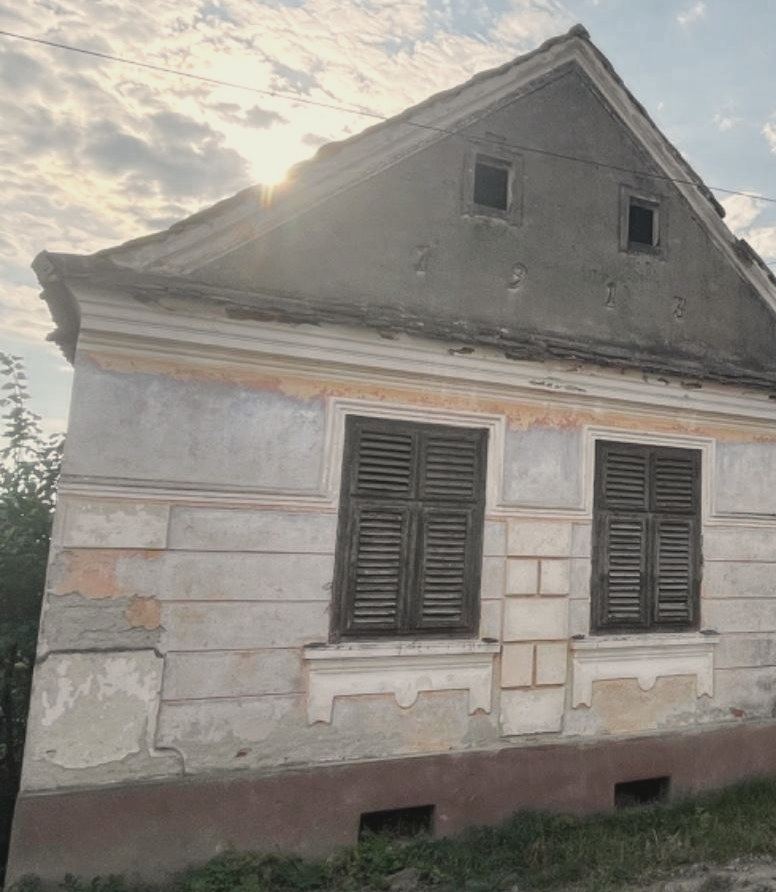
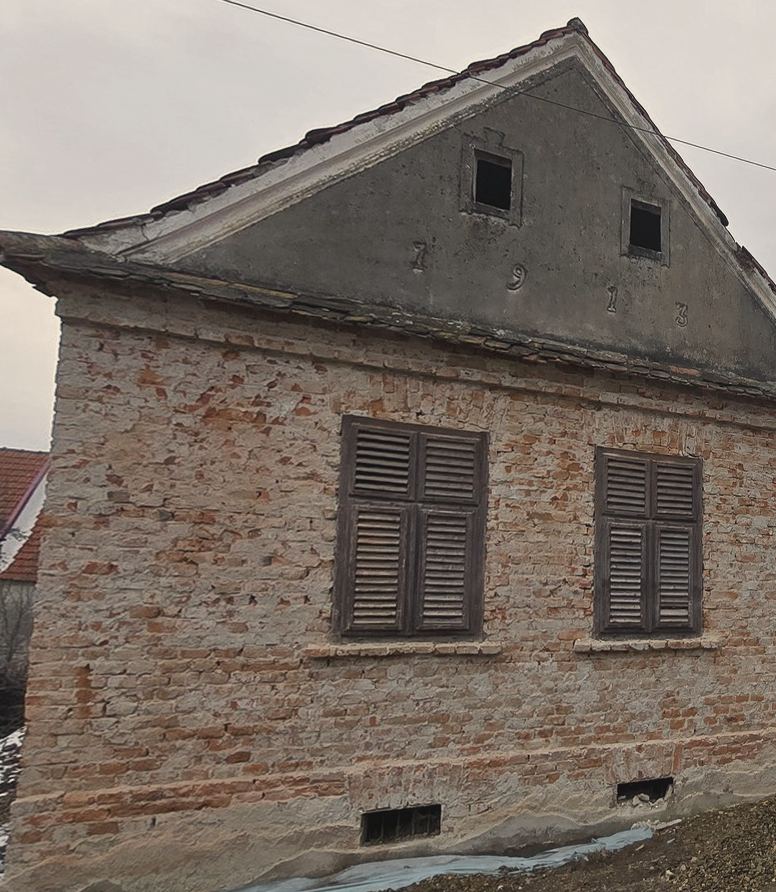
Casa Miruna, a village house with 1913 on its street gable, seen in four stages: as the family found it, in summer; back to its old brick in January 2025; during the work, with the new roof on and the stair tower rising; and as designed. The work is planned to finish in 2027, and the first guests come in summer 2028.

1 As found, summer, before the work

2 Back to the brick, January 2025

Photograph, summer, before the work: the street front of Casa Miruna in old off-white plaster, the gable with the date 1 9 1 3 and two small openings, two shuttered windows below.
Photograph, January 2025: the same street front with the plaster taken off down to the old brick; the gable, its date and the shutters are unchanged.
Summer, before the workSummer January 2025
Drag to compare the street front in summer, before the work, and in January 2025, back to its brick. Both are the family’s photographs; the second is straightened a little to line up.

Through the carriage gate there is a courtyard with its old well. Behind the house stand the barn, which stays, and the fruit trees, with the village’s strip fields beyond. On the pole in the street by the gate there is a storks’ nest.

Photograph, before the work: the barrel vault of the cellar in old red brick, over a plastered stone wall.
BeforeThe brick vault of the cellar. It keeps its brick.
Photograph of a pen sketch on paper: a plan of the house as a row of rooms along the courtyard, labelled in Romanian, and below it the courtyard front with its doors and windows.
An early sketch of the house: three rooms, the kitchen, the stable and the shed along the courtyard, the street on the left. The labels are in Romanian.

3 During the work

The new roof goes on behind the old gable, and in the courtyard the half-round stair tower rises.

Photograph from the street, during the work: the old grey gable with two small openings, and behind it a new roof of orange tiles with four roof windows over bare new timbers; in front, an old wall with an arched gateway, and at the top left a storks’ nest on its pole.
During the workFrom the street: the new roof behind the old gable, and the storks’ nest on its pole.
Photograph, during the work: the half-round stair tower in red brick rising in a sandy courtyard, two ladders against it and the timber frame of its cone roof; behind, the new tiled roof with roof windows and bare timbers, scaffolding, stacked planks and an old wooden carriage gate.
During the workThe stair tower rises in the courtyard, under the new roof.
Photograph, during the work: new tiled roofs with roof windows and the stair tower under its cone roof; in front, a heap of rubble and a yellow telescopic loader, and on the right a new brick wall under a timber eave.
During the workThe new roofs and the stair tower.

4 As designed

Drawing over the summer photograph of the street front: in ink, the old roofline traced along the top of the gable, and above it, out of the photograph, the new roof as planned, about a metre and a half higher.
As plannedThe same roof as planned, drawn over the summer photograph (compare the street view during the work, above): about a metre and a half higher, with the old roofline kept on the wall, above the date.

When the work is done, the half-round stair tower, the summer kitchen under its new cantilevered roof and the studio will stand around the courtyard. Downstairs, travertine floors under white limewashed vaults; upstairs, in the attic, four guest rooms, each with twin beds that zip into a double and its own shower room, each named after a village of this valley where potters once worked.

  • BuciumUnder the street gable · about 22 m²
  • BreazaEast of the stair · about 18 m²
  • ToderițaOver the kitchen · about 17 m²
  • CârțaAt the east end, over the courtyard · about 16.5 m²

Two places as they were, beside their design: the attic where the four rooms will be, and the garden.

Photograph, January 2025: the long attic under the old roof timbers, lit by two small gable openings at the far end.
January 2025The attic under the old roof, where the four guest rooms will be.
Bucium about 22 m² Breaza about 18 m² Toderița about 17 m² Cârța about 16.5 m² stair showers showers hall stair tower street gable, west courtyard, south 2 m N
PlanThe attic as planned, drawn from the architect’s current plan; walls may still move. Swipe to see the whole plan.
Photograph, summer, before the work: the back of the old house with its tiled roofs and two brick chimneys, seen across the overgrown garden.
BeforeThe garden behind the house, in summer, before the work.
Visualisation: the courtyard and garden as designed, seen from above the stair tower: a path across the lawn to the summer kitchen and the studio, planted terraces along the wall, and the planned pool beyond. Visualisation
VisualisationOne of the garden designs under consideration. The pool is planned and not yet built.

The work is planned to finish in 2027; the first guests come in summer 2028.

We plan to send photographs of the work, as it goes, in the Letters from Vad.

Summer, 2028

Five weeks, June to September, and a sixth if the list is long enough.

  1. 10–17 JuneFlower, Spiral, TulipPlates and bowls painted with the flower, the spiral and the tulip, symbols of Romanian ceramics, in cobalt and orange. The founding week: six makers.All levels
  2. 24 June–1 JulyHorn and SlipWhite slip and the cow horn, the way the potters of this valley decorated. We plan to invite a potter from Horezu.All levels
  3. 15–22 JulyCreatures and BirdsFigures, birds, whistles, candle holders. In the old Romanian calendar July is Cuptor, the oven; in Vad it is cooler than the name.All levels; ideal for a first time
  4. 12–19 AugustA sixth weekOnly if the waitlist is long enough: a repeat of whichever week fills first.All levels
  5. 26 August–2 SeptemberThe Potters’ FairRomanian clay, from Saschiz sgraffito to the horn, and the way home through the Potters’ Fair in Sibiu, on the first weekend of September (its 2028 date is the organisers’ to confirm).All levels
  6. 9–16 SeptemberBlack Clay and FireBlack stoneware, lines cut and filled with white, burnishing, raku and a barrel smoke firing. Twelve test tiles each, and the studio open late.For people who already make

€1,850 a maker sharing a room · €2,350 in a room of your own · €1,150 a partner who doesn’t make planned

About €265 a day for your room, every meal with wine at dinner, the teaching, the materials and firings, the day out and the airport cars. Your flights and travel insurance are your own.

For the waitlist, a founding rate (planned: €200 off a maker’s place) if you book in the list’s fortnight, 15–28 November 2027.

Come to my home in Vad.

Keep me a place

On the list you book first, from 15 November 2027, at a founding rate (planned). If you like, I will also write to you from Vad about four times a year, as the house comes back to life.

Tell me a little more (optional)
Write to me in
Your clay so far optional
Weeks that tempt you optional
Coming optional
Room optional
0 / 300
How did you hear of us? optional

I will send you the 2028 dates and your booking window, and nothing else unless you tick the box for the Letters.

* required: only your first name and your e-mail. No phone, no address. How your details are looked after

What the list gives you, and when

  1. 1 Mar 2027The first Letter from Vad, if you asked for the Letters; then about four a year.
  2. Sep 2027The whole week tried out with six makers (planned). Before the dates go out, you will see here the photographs of that week, the finished house and studio, and what the six makers said.
  3. 1 Nov 2027The 2028 dates and prices, and the booking terms, before anyone else.
  4. 15–28 Nov 2027Fourteen days to book first, at a founding rate (planned: €200 off a maker’s place). The six places of the founding week, 10–17 June, go to the list in the order people joined (planned).
  5. 1 Dec 2027Booking opens to everyone; the list keeps first call on any place that frees up.
  6. 10 June 2028The first week begins.

Kiln opening

On Saturday at half past seven we open the kiln. Breakfast waits.

Two of Miruna’s storytelling candle holders, one on a beaded stem and one walking on long legs with a white candle, in front of a bowl with an orange rim, on a wooden table in a dark room.
Candle holders from the fifty Miruna made for a wedding table.